

The History of Stow Mill, built 1825-27
The tarred brick tower mill at Stow Hill situated on the west side of the coast road from Mundesley to Paston was built as a flour mill between 1825 and 1827 by James Gaze.
The land on which the mill was built had been acquired by Thomas Gaze (1), gentleman of Paston Hall from a John Taylor, yeoman, under an Indenture of Ffeofment dated 28th January 1778 – a method of conveyance abolished in 1845.
Thomas Gaze died in 1805 and the land passed to his son, Thomas Gaze (2), and then to his son James. In 1827 James Gaze, “being desirous of making provision for his said son in order to advance and prefer him in the world” conveyed to his eldest son, Thomas Pleasants Gaze for the nominal consideration of ten shillings of lawful British money….
ALL THAT messuage tenement or dwellinghouse with the yard and garden containing by admeasurement thirty perches or thereabouts…AND ALSO all that pightle of land called the oat pightle otherwise the oak close thereto adjoining…one acre one road and six perches or thereabouts TOGETHER with the tower windmill lately erected and built by the said Thomas Gaze on the same piece or parcel of land with the consent of the said James Gaze his Father…in Paston aforesaid and in Mundesley…
Along with the Lease and Release dated 12th and 13th October 1827 from which the above script is taken, a mortgage was prepared and taken out by Thomas Gaze for £900 to Mr. Christopher Shephard of Heigham, for the house, land and mill and also…
ALL AND SINGULAR the sails, sail cloths, going gears, stones, tackle, apparel, furniture, materials, implements and appurtance whatsoever to the said windmill…belonging or used therewith…
The house, mill and other outbuildings were to be insured against fire for at least £800. The mortgage was evidently to pay for the cost of the erection of the windmill, but it is worth noting from the first text above that son, Thomas must have been instrumental in the building of the mill itself, albeit with the consent of his father and at his initial expense. In the Lease, Thomas is described as a Miller of Paston.
On the 6th November 1828, one year later and with the mill now in operation, a further mortgage to Mr. Christopher Shephard was taken for £150 to pay for the building of a granary.
There had been another mill in Paston, which was demolished in 1840, when its material and equipment were sold piecemeal by auction. With the loss of this mill in Paston, it appears the local populace adopted the name of Paston Mill for Stow and it remained so for many years and continues to be rumoured. The owners, without conclusive proof of either, can only refer to Ordnance Survey maps on which it appears as ‘Stow”.
Thomas Gaze worked as the miller of Stow Mill for 45 years until his death in 1872.
The windmill and a steam mill which had been installed in the granary were offered for sale by auction:
Norfolk Chronicle – 14th June 1873
MUNDESLEY AND PASTON
To be sold by Auction by order of the Executors of Thomas Gaze deceased by Mr. Thomas Barcham on Thursday 3 July 1873 at the King’s Arms Hotel, North Walsham at 6 o’clock. Lot 1 A BRICK TOWER WINDMILL in Paston in capital repair driving two pairs of Stones, with Flour Mill, Jumper and all necessary tackle and gear. Also a STEAM MILL erected a few years since, driving two pairs of Stones with the five-horse power engine and apparatus thereto belonging. Also a comfortable Brick and Tile RESIDENCE with Granaries, Stable, Cart Lodge and Outhouses thereto belonging. FREEHOLD.
The Mill is now doing a flourishing business. Possession at Michaelmas next.
Apply to Mr.Wilkinson, Solicitor, North Walsham or the Auctioneer, Mundesley.
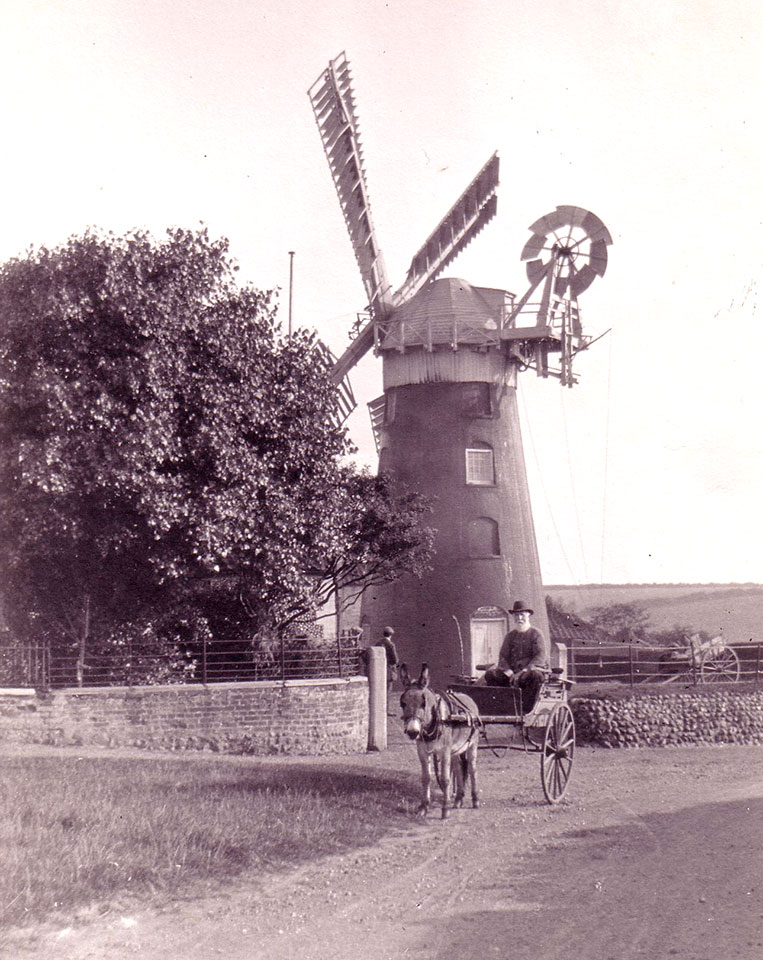
Ted Lee, village postman delivering mail c.1920
However, the property was not sold, and the business was carried on by the son of Thomas Gaze, William, who worked on behalf of himself and the co-executors until the estate was wound up in 1875 when the properties were conveyed to him. William continued milling at Stow until he died in 1906.
The property was then bought from William Gaze’s estate by Mrs. Mary Ann Harper on 15th December 1906 and her cousin, Thomas Livermore took a yearly tenancy of the mill in 1907.
Mrs. Harper died in January 1928 and left the mill to Mr.Livermore who worked it until 1930. Milling then came to an end at Stow Mill.
The property was then purchased by Mr. and Mrs. Bell who renovated and greatly enlarged the miller’s house (standing on the south side of the mill), whilst the mill, like others on the North Norfolk coast, had her machinery removed and was converted into an annex for extra living accommodation.
At this time, for some reason, a “bolter” from the mill was sent to the Science Museum by Rex Wailes, a windmill historian. Unfortunately, though it disintegrated from it’s infestation of woodworm.
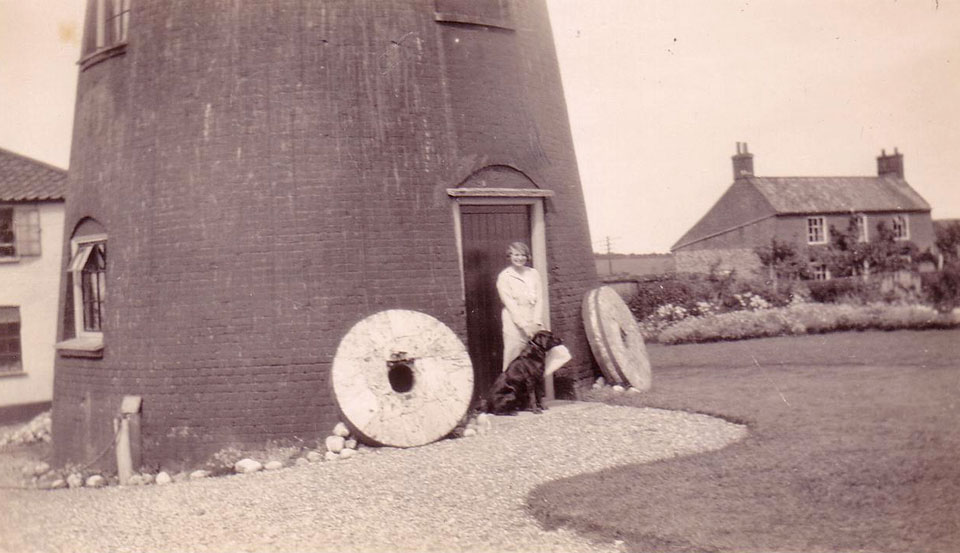
Mrs.Bell and Rock outside mill 1933
By 1938 a new holiday camp had been built along the road opposite the mill, the first of its kind in Britain.
Mr. and Mrs. Bell, fearful that their peace and tranquillity had been spoilt forever, sold on to a certain Mr. Douglas Sydney Arundel McDougall, the flour producing magnate, who used it as a holiday home.
1960s
The property then passed to a Miss F. M. Noble but was again purchased in 1960 by a Northampton businessman, Mr. C. M. Newton. In 1961 the windmill was selected by the Norfolk County Council amongst others in the county “as worthy of financial assistance towards preservation”.
Four new sails and a skeleton fantail were fitted by Messrs. Thompsons, millwrights of Alford, and the remains of the 1930 kitchen sink unit and bath were removed. The mill was then opened to the Public for the first time.
1970s
In 1971 the mill was conveyed to Mr. Newton’s grandson, Mr. C. M. B. Newton who enlarged the old granary barn beside the mill and converted it to his home. With the help of admission fees at the door of the mill, he undertook its maintenance.
In 1977 the mill was leased to Norfolk County Council by Mr. Newton, for the nominal sum of one peppercorn per annum and further restoration work began. However, this lease was terminated on 1st December 1981.
It was Mike Newton’s hope to see the mill working again and it was he who organised replacement of the two Columbian pine stocks for galvanised steel; the second of which with the help of a fund-raising appeal in the local area.
1980s
In 1980 some repair work was carried out to the curb castings which enabled the cap to be turned for the first time in 50 years. In 1986, he installed an upright shaft with a wallower taken from Houghton Mill, and collected two pairs of millstones from Nedging Tye in Suffolk, plus a great spur wheel from Gooderstone Mill in Norfolk. However, these were never put into place.
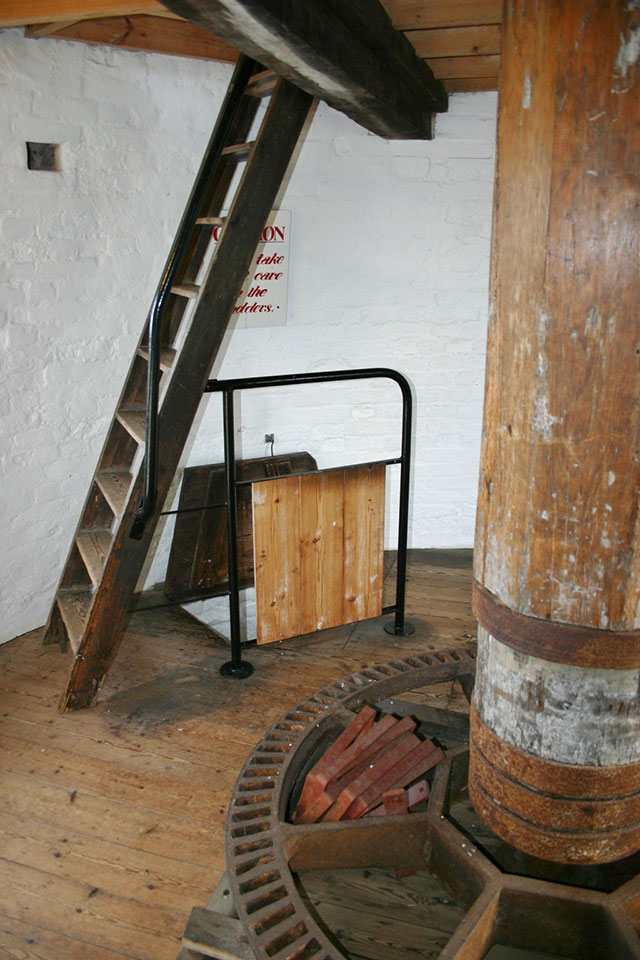
Bin floor, now the bedroom
1990s
In January 1999 Stow Mill together with the adjacent cottage was sold to Roger and Andrea Hough. With no experience whatsoever of windmills their first job was to ascertain the condition of the mill and its future.
They considered restoring the Mill to working order but the cost was prohibitive. However continuous works were undertaken on the ongoing refurbishment of the building itself.
2000s
In 2002 it was decided to transform the garage at the front of the cottage into a souvenir shop which successfully ran for 10 years whilst the windmill remained open to the public.
Unfortunately, due to the recession and falling demand Roger and Andrea shut the doors to the shop in 2013.
Conversion to a holiday home and restoration
Roger and Andrea began to research the possibility of converting the Mill into a holiday let. This was an ambitious plan and they first needed a design that would be both sympathetic and worthy of the Mill, followed by detailed plans that would achieve local planning and listed building approval, then expert trades people to deliver the fit out along with funding, not to mention the prospect of project managing the whole process from start to finish.
Having had many discussions with architects, conservationists and town planners, a design was eventually put forward for planning approval, but this was refused, as was a revised application. A third application was successful, but Roger felt the design unrefined and set about a resolution that would be in line with his vision and that would gain planning approval. Roger was able to leverage knowledge gained from his brother Clive, a qualified architect, from the time they had worked together. After 3-years and four planning applications, Roger and Andrea’s patience and determination paid off when in 2016 Roger’s design, put together with the help and assistance of Peter Hilling of PH Design & Planning Limited in North Walsham, was approved. It was this design that was built and received the highly commended LABC award in 2019 in the category of Best Change of Use of an Existing Building.
Roger and Andrea found and worked alongside local master tradesmen with the skills to deliver their vision, on receiving planning permission in 2016. It took 2-years to complete the conversion of the Mill and its transformation into a quite spectacular holiday home.
Part of their vision was to re-establish Stow Mill as a ‘working’ windmill, with a Cap that could and would rotate freely, putting the Mill’s sails into the prevailing wind, along with restored sails that could turn in the wind.
Roger and Andrea commissioned Millwright, Paul Kemp, to undertake an assessment of the Cap and remaining machinery within it. Unfortunately, weather damage, the weight of the galvanised steel stocks installed in the 1970’s and failing parts of the structure within the Cap meant it was deemed dangerous and unsafe. The sails, then the stocks, followed by the whole cap would have to be removed from the tower and a complete and thorough restoration undertaken.
Two 50-foot lengths of Douglas Fir were purchased to be shaped into new stocks, along with a huge 1-tonne piece of oak for the new weather beam. These were laid to ‘season’ in the grounds of the Mill for 2-years.
In July 2018 the first guests were welcomed into the newly converted Mill while, with the Cap still in place, initial restoration works by the Millwright began away from site.

Old cap lowered to ground ready for restoration work and temporary roof in place on mill
In April 2019, after a very successful 9 months of holiday lettings, the Mill was again closed to visitors. The Cap was lifted off from the tower by crane to rest on the grounds in front of the Mill whilst a temporary roof was installed on the open tower.
Restoration work began on the fantail stage. The boarding at the front of the cap was then dismantled and opened to allow access to the rotted weather beam which was removed and the supporting front shears were repaired.
At the top of the tower, with the cap removed, an inspection was made of the curb, on which the rollers carry the 10 tonne load that enables the sails to move into the wind. It was discovered that most of the old metal sections were broken and new steel sections needed to be cast.
After 12 months of work, the repaired cap, complete with a new weather beam, repaired upper curbs, new fantail and stage, was lifted back onto the replaced rollers and new cast curbs on the top rim of the tower.
Following a further month of shaping and painting, the new stocks, with new sails, were lifted back into position completing Roger and Andrea’s vision for Stow Mill as a fully restored and ‘working’ windmill.
Since milling ceased in the early 1930’s Stow Mill had stood silent and broken, repaired only to a cosmetic standard. Now it stands as proudly as it did when it worked to mill flour almost 100 years ago and is once again a ‘working windmill’ with a purpose. Through their vision, determination and passion for this historic landmark in North Norfolk, Roger and Andrea Hough gave new life and a new purpose to Stow Mill. As a magnificent place to stay in a beautiful part of the country, Stow Mill is generating its own income once again funding its ongoing high standard of maintenance and its preservation as a ‘working windmill’ for many years to come.
With an established, highly sought after and exclusive holiday let business now established, Roger and Andrea were ready to move on to the next chapter in their lives and in March 2022 sold Stow Mill to Robin and Anita Booth.
Current owners
Robin and Anita were both born and brought up in Yorkshire, moving down to the home counties as their careers progressed. Robin is a graduate of the University of East Anglia and along with their two (now grown up) children, the Booth family had several holidays in Norfolk and so know many of the delights the area has to offer visitors and residents alike. On taking early retirement from their professional careers, a move to the North Norfolk coast was very appealing to them both and they have made the Mill their business venture and the Cottage next door their home.